Alright, sit down for this one because I have OPINIONS about pool robots. I’ve been running the AIPER Scuba V3 for six weeks now, which is about long enough to stop being seduced by the unboxing experience and start noticing what actually annoys you on a Wednesday morning at 7am. This is going to be the no-marketing-bullsh*t take from someone who’s owned four pool cleaners and is genuinely tired of the genre.
Short version for the impatient: it’s the best one I’ve owned, the AI claims are 70% real and 30% PR hype, and the wireless charging dock is the feature I didn’t know I needed until I had it.
Long version below.
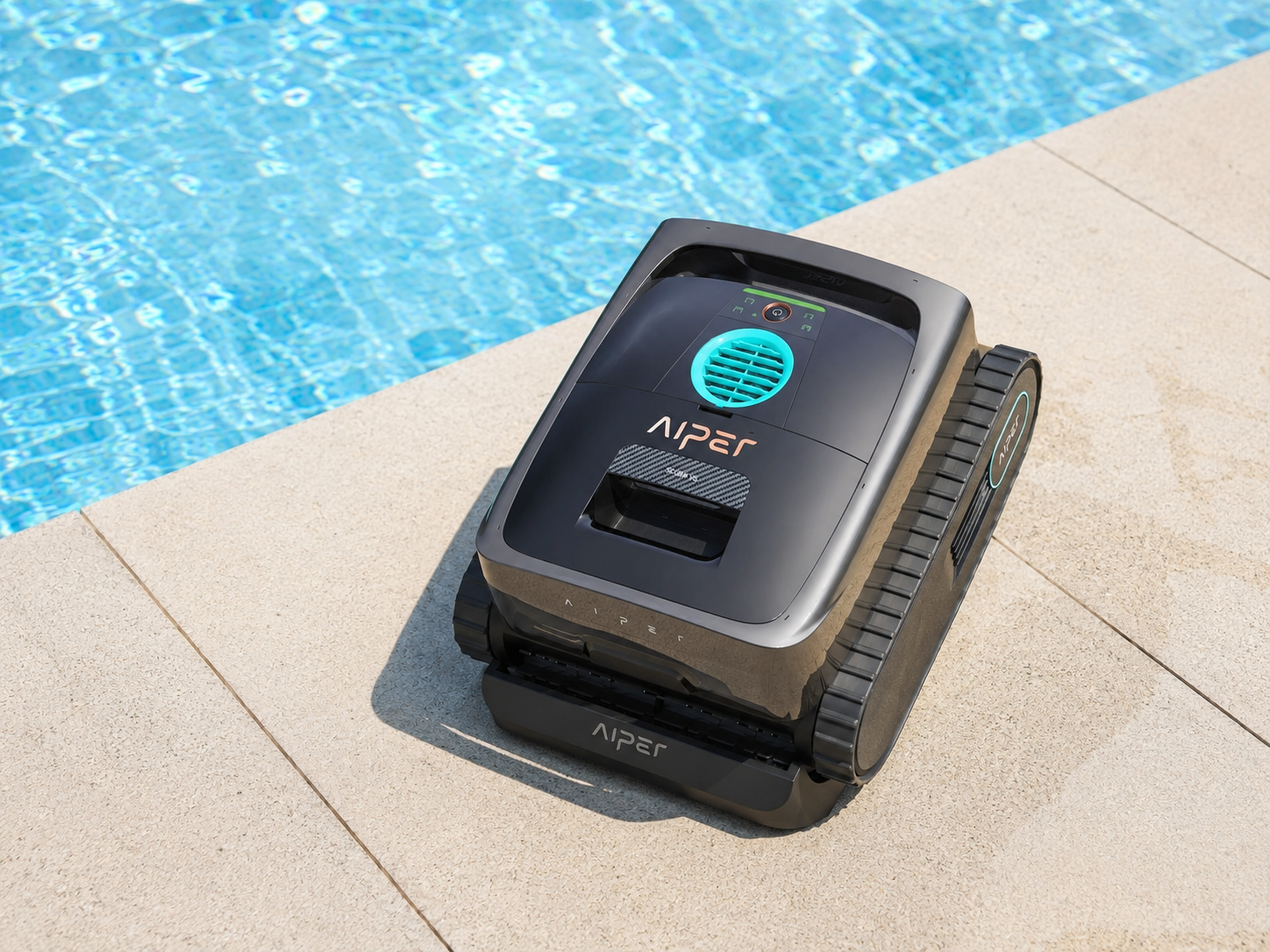
Table of Contents
Open Table of Contents
- Why I Replaced My Old Pool Cleaner With the AIPER Scuba V3
- What the AIPER Scuba V3 Actually Is (And What’s New for 2026)
- Six Weeks of Real-World Use: What Actually Happens
- The Wireless Charging Dock: Bigger Deal Than It Sounds
- What I Don’t Love About the Scuba V3
- AIPER Scuba V3 vs the Competition in 2026
- Who Should Actually Buy This
- Setup, Maintenance, and What Actually Wears Out
- A Few Questions I Keep Getting Asked
Why I Replaced My Old Pool Cleaner With the AIPER Scuba V3
Quick backstory so you know where I’m coming from. I’m not a pool industry guy, I’m a homeowner who bought a house with a 16x32 inground pool in 2017 and has been steadily increasing my hatred of pool maintenance ever since.
Cleaner history:
- Polaris 280 pressure-side (2017-2024). Worked, sort of. Needed a booster pump. Hose tangled constantly. RIP.
- Hayward Navigator suction-side (briefly in 2022). Returned it. Kept eating itself.
- Generic corded robotic (2024-2025). Worked great. Cord situation made me want to move.
- AIPER Scuba V3 (current). This is the one I’m reviewing.
The thing that finally pushed me to upgrade wasn’t a feature, it was a moment. I was standing on my pool deck in March trying to untangle a 50-foot extension cord from a 50-foot pool cleaner cord, in flip flops, in the rain, while my dog tried to drink the pool water. I bought the Scuba V3 that afternoon.
You can check the current AIPER Scuba V3 price on Amazon — it fluctuates with seasonal sales but it’s been consistently in the upper-mid premium tier of cordless robots.
What the AIPER Scuba V3 Actually Is (And What’s New for 2026)
This is the 2026 flagship from AIPER, and it’s a pretty meaningful jump from the Scuba S1 they were selling last year. Here’s what’s actually in the box and what each thing does in real life:
- AI Vision camera — front-facing camera that identifies 20+ types of debris and navigates toward them instead of bumping around randomly
- VisionPath adaptive path planning — uses the camera plus dToF (time-of-flight) sensors to map your pool and avoid re-cleaning the same patch four times
- Cognitive AI Navium Mode — autonomous weekly cleaning schedule that learns your pool’s pattern
- JetAssist horizontal waterline cleaning — uses water jets plus the brush to scrub the tile line above and below water
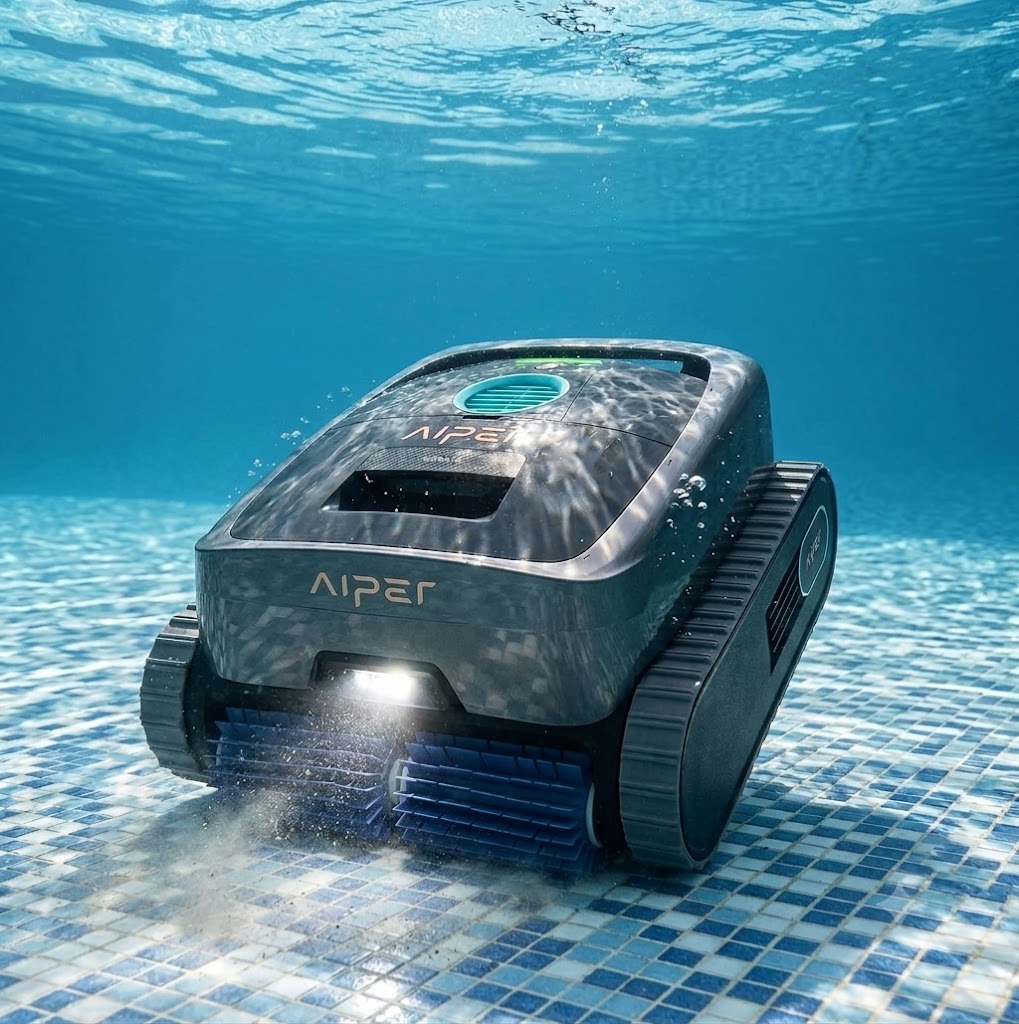
- Dual brushes + 4800 GPH suction — the actual cleaning grunt work
- MicroMesh multi-layer filtration — 180 micron outer layer for leaves and twigs, 3 micron inner layer for sand and pollen
- Wireless charging dock — set the robot on the dock, it charges. No plugs, no exposed connectors
- Featherlight design — 8.2 kg (about 18 lbs), the lightest premium cordless robot AIPER sells
- Auto-retrieval to waterline — robot parks at the surface and sends a phone notification when done
That’s the spec sheet. Now let’s talk about what actually matters when you own one.
Six Weeks of Real-World Use: What Actually Happens
I’m going to walk through this by what I think you actually want to know, which is different from what AIPER’s marketing emphasizes.
The AI Vision Stuff Is Genuinely Different
Okay, I was the most skeptical about this. Every robot vacuum company adds “AI” to their box and 90% of the time it means literally nothing changed inside. The Scuba V3 is one of the cases where it actually means something.
Watch the robot for ten minutes and you can see it doing something my old corded robot never did. It’ll be cruising along, then suddenly veer off course toward a specific spot. You look at the spot — there’s a clump of leaves there. It saw them. It’s going to them. This is not random pattern movement, this is targeted cleaning.
AIPER claims the AI Patrol system is “up to 10x faster” than traditional methods. Is it 10x faster? In my pool, no. It’s maybe 2-3x faster at noticing specific debris piles. But “noticing specific debris piles” is genuinely a thing it does, and I’ve never owned a cleaner that did that before. Net positive.
Navium Mode Is the Feature I Actually Use Most
This is the one nobody talks about in reviews and it’s the best feature on the device.
You turn it on once in the app. You tell it your pool size. It then builds a weekly cleaning plan based on its own data — it learns when your pool gets dirtier (mine: Mondays after weekend use, Fridays before weekend use), and it schedules cleaning cycles around that. Then it just… does the cleaning. Forever. Without me.
I haven’t manually started a cycle in three weeks. I plug the robot into the dock, the dock charges it, the robot decides when to clean, it cleans, it parks at the waterline, it pings my phone, I lift it out with a hook pole, I put it on the dock, the cycle repeats.
This is what every pool cleaner should have been doing five years ago. It’s not flashy and AIPER doesn’t lead with it because “set it once and forget it” isn’t sexy marketing copy. But it’s the difference between owning a pool cleaner and not really thinking about the pool cleaner.
Cleaning Performance on Specific Things
Fine dust and pollen. The MicroMesh 3-micron inner layer is no joke. I’m in an oak pollen war zone every April and the V3 handles it. The cartridge comes out looking like someone dumped a jar of yellow chalk into it. My previous cleaners would push pollen around the pool floor in slow-motion swirls. The V3 actually captures it.
Leaves. Handles it fine. I have a big sycamore tree about 30 feet from the pool. After a windy day there’s a thick layer of leaves on the bottom. The Scuba V3 doesn’t get every single one in one cycle, but it gets 90% of them, and the AI Patrol means it spends more time on the heavy patches.
Sand and grit. Excellent. The 3-micron layer catches stuff I didn’t even know was in my pool. When I empty the cartridge into a bucket of water you can see actual sand on the bottom. Where was this sand coming from before I had this robot? I genuinely don’t know.
Algae prevention. This is brushing-dependent and the V3’s dual brushes are aggressive. I haven’t had visible algae in six weeks of normal-chemistry pool care, including one week where I was traveling and let the chlorine drop too low.
Big debris (twigs, acorns). The bay handles it, but if you have a tree dropping huge stuff constantly, you should also have a leaf trap on your skimmer. No robotic vacuum is going to keep up with a sycamore in fall by itself.
JetAssist Waterline Cleaning Is Better Than I Expected
This was the second feature I was skeptical about. Most “waterline cleaning” modes I’ve seen are basically just the robot pretending to drive along the surface while not actually scrubbing anything meaningful.
JetAssist on the V3 does something different — it uses water jets to push the brushes against the tile, even when the robot itself is below the surface. The result is that the scrubbing happens up to about 2 inches above water level. After six weeks of using it once a week, my waterline tile is the cleanest it’s been since the pool was built.
For context: I live somewhere with hard water and my waterline used to develop a calcium ring within a month. I’d have to manually scrub with a pumice stone every 4-6 weeks. I haven’t touched the tile manually since I got the V3.
The Wireless Charging Dock: Bigger Deal Than It Sounds
This was the spec I was the most “whatever, nice to have” about, and it turns out to be the feature that changed my pool routine the most.
Here’s the previous cordless robot ownership experience: cycle ends. You lift the robot out (drippy). You let it dry. You open a little rubber port that’s always slightly stuck. You plug in a barrel-jack charger. You hope the rubber port seals well enough to keep water out next cycle. You worry about corrosion. You repeat 100+ times a year.
With the wireless dock: cycle ends. You lift the robot out (drippy). You put it on the dock. That’s it. There’s no port to open. There’s no plug. The robot starts charging via induction. There is literally no way for water to get into anything because there are no exposed contacts.
I cannot tell you how much mental load this removes. The charging port on my last cordless was the part I worried about constantly because if it ever corroded I’d be hosed (literally). The V3’s dock eliminates that worry entirely.
The dock also keeps the robot stored cleanly — not sitting in a pile on the deck. My wife stopped suggesting we hide it in the shed.
What I Don’t Love About the Scuba V3
Not a paid advertisement. Here’s what bugs me:
The app is fine, not great. It works. Pairing was painless (took maybe 90 seconds). But the UI feels like someone read a list of features and built screens for each one without thinking about flow. There’s no main dashboard that just tells you “robot is charged, last clean was Tuesday, next clean is Thursday.” You have to dig through tabs to find that. Fixable in a software update, presumably.
The waterline parking sometimes misses. Robot is supposed to return to the waterline and park there for retrieval. About 1 in 5 cycles it parks in a slightly weird spot, like in a corner you can’t reach without a hook pole. Once it parked underwater because the battery died right at the end of the cycle. Minor annoyance, not a dealbreaker.
No serious manual control. You can start, stop, and pick modes. You cannot drive it like an RC car to spot-clean a specific area. Some competitor cleaners now offer this and it would be useful for the occasional “oh god a kid spilled cereal in the deep end” situation. Maybe an OTA update someday.
Wall climbing is good but not elite. It climbs walls. It does not crawl all the way up to and over the waterline tile the way some premium Dolphins do. The JetAssist mostly compensates for this, but if you have a tile design where the actual tile extends well above the water, the V3 will scrub the bottom edge and miss the top.
The price. Look, this is a real cost item. The V3 is meaningfully more expensive than basic cordless cleaners. If your pool is small, simple, and you mostly need floor vacuuming, you do not need this robot.
AIPER Scuba V3 vs the Competition in 2026
The cordless robotic market in 2026 is suddenly crowded. Quick honest take on the main options:
| Feature | AIPER Scuba V3 | Dolphin Nautilus CC | Dreame Z1 Pro | Beatbot AquaSense Pro |
|---|---|---|---|---|
| Cord | Cordless | Corded | Cordless | Cordless |
| AI Vision | Yes | No | No | Yes |
| Waterline | JetAssist (excellent) | No | Yes (decent) | Yes (excellent) |
| Suction (GPH) | 4,800 | 4,200 | 8,000 | 5,500 |
| Wireless dock | Yes | N/A | No | No |
| App control | Yes | No | Yes | Yes |
| Weight | 8.2 kg | 6.4 kg | 11+ kg | 10+ kg |
Dolphin Nautilus CC is the value pick. It’s corded, it’s cheaper, and the cleaning performance is honestly comparable for the basic stuff. If you don’t care about waterline or AI features, save the money.
Dreame Z1 Pro has more raw suction power and a longer runtime. If you have a massive pool (think 1000+ sq ft surface area), it might be the better choice. Heavier to lift out.
Beatbot AquaSense Pro is the closest competitor to the V3 spec-for-spec. Slightly better at waterline, slightly worse battery life, more expensive. Pick on price when you’re buying.
For my use case — average inground pool, hard water, hate maintenance — the V3 wins.
You can see the current Scuba V3 listing and price on Amazon — it’s bouncier on price than the others because AIPER runs more frequent promotions.
Who Should Actually Buy This
The V3 makes the most sense for a medium-to-large inground pool where hard water and waterline calcium are a recurring headache, and where you want to genuinely stop thinking about pool cleaning schedules. The Navium Mode and wireless dock together create a setup where the robot handles its own life — you’re just the person who lifts it out of the water.
Where it doesn’t fit: small above-ground pools (the AIPER Seagull SE does the job for a lot less money), pools over 1,000 sq ft where the battery won’t cover one full cycle, and anyone on a tight budget who’d be better served by the Dolphin Nautilus CC at 75% of the experience for less cash. If your main use case is basic floor vacuuming on a simple pool, there’s no reason to pay for AI Vision and JetAssist you won’t use.
Setup, Maintenance, and What Actually Wears Out
Setup time: Maybe 20 minutes total. Charge the robot for 4 hours. Download the app. Pair (90 seconds). Tell the app your pool size and shape. Done.
Routine maintenance:
- After each cycle: rinse the MicroMesh cartridge under a hose. Takes 60 seconds.
- Weekly: pull the cartridge apart and rinse the inner layer. Takes 3-4 minutes.
- Monthly: deep clean the brushes (hair, pool toy string, leaves). Takes 5 minutes.
- Quarterly: wipe down the camera lens with a microfiber cloth. Takes 30 seconds but matters.
What wears out:
- MicroMesh filter cartridges: about once a year, $30-40 for a replacement set
- Brushes: about every 18 months under normal use, $25 for a pair
- Battery: AIPER rates it for 1000+ cycles, roughly 4-5 years of weekly use. Two-year warranty with advance replacement covers the early period.
Six weeks in I’ve done nothing but rinse the cartridge. Total time on pool cleaning maintenance: maybe 8 minutes. Total time on my old Polaris setup over the same period: probably 4 hours when you count the hose untangling.
A Few Questions I Keep Getting Asked
How long does the battery actually last? About 110 minutes of real-world floor + walls + waterline in one cycle before it parks at the waterline. AIPER’s official range is 150-180 minutes depending on mode. Wireless dock recharges it in under 4 hours.
Does it work with saltwater? Yes. I have a saltwater pool. The brushes, plastic housing, seals, motor, and battery are all rated for it.
What about stairs? The AI vision routes around standard stairs reasonably well. Roman stairs and beach entries are still tricky — I brush mine manually about once a month, which is fine.
How does it compare to the Scuba S1? The V3 adds the AI Vision camera, JetAssist waterline cleaning, wireless charging dock, and Navium autonomous scheduling. The S1 has none of those. It’s also significantly cheaper now that the V3 launched, so if you want the AIPER cleaning quality without paying for the AI features, the S1 is worth a look.
Does it need the app to work? No. One-click manual start button on the device, runs a default floor + walls cycle. The app unlocks Navium Mode, scheduling, and retrieval notifications — that’s where the real value is, but the robot cleans fine without it.
Honest disclosure: I bought my AIPER Scuba V3 with my own money for normal pool ownership. As an Amazon Associate I earn from qualifying purchases made through the product links in this review, at no additional cost to you. All opinions are my own and based on 6 weeks of daily use. I’ll update this post at 6 months and 1 year.